
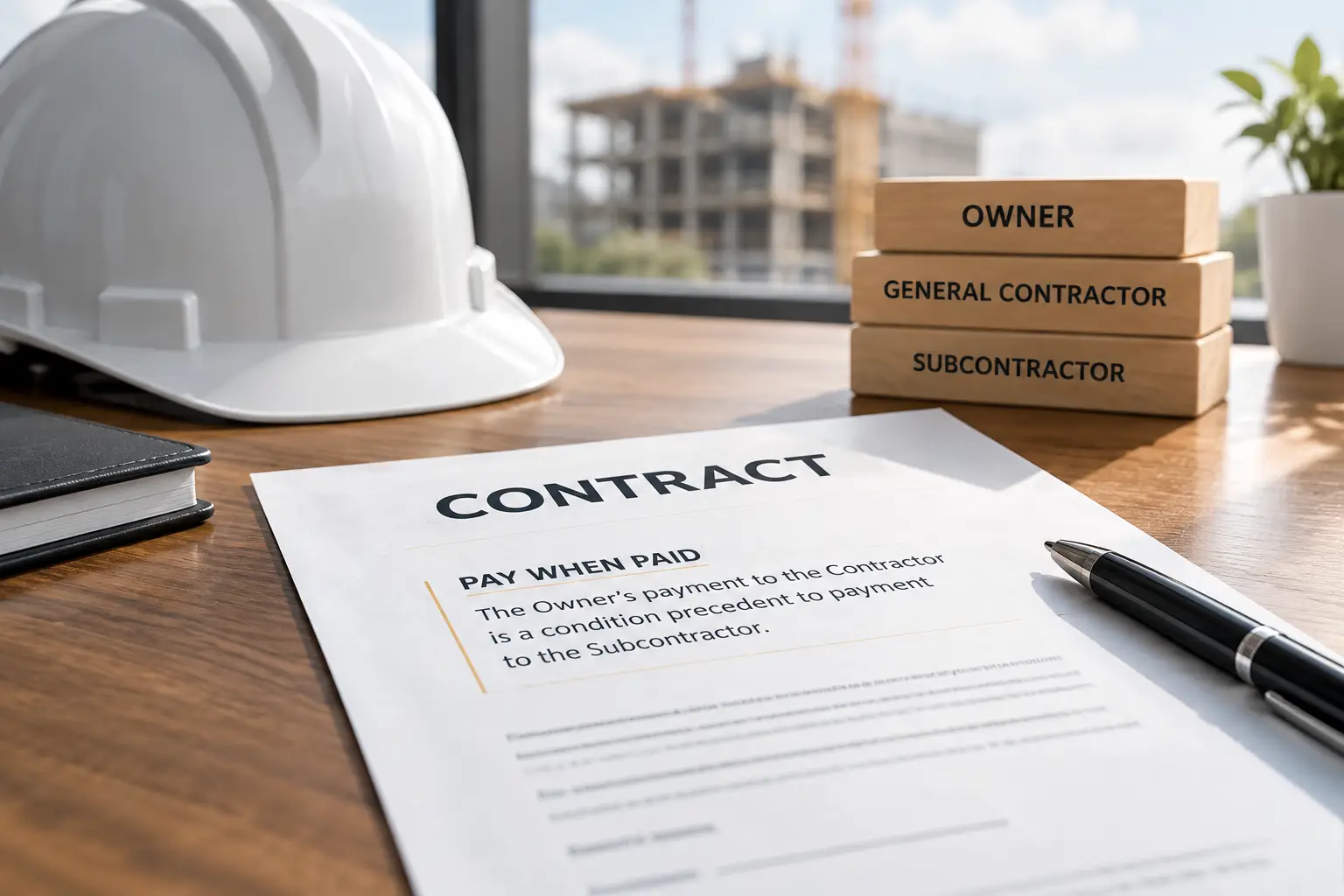
There is a contractual landmine that has taken down more subcontractors than bad estimating, bad crews, and bad luck combined.
It does not announce itself. It sits quietly in the middle of a contract, in a section most people skim because they assume nothing important lives there. It runs two or three sentences. And it says that the general contractor does not have to pay you until the property owner pays them.
Read that again, because of what it actually means. Your payment now depends on someone you have never met, never negotiated with, and have no leverage over whatsoever.
My position on this is not complicated. Under no circumstances should you sign a contract with a pay when paid or pay if paid provision. The moment you do, you have handed control of your cash flow to a party who owes you nothing.
What a Pay When Paid Clause Actually Does
The plain English version
A pay when paid clause ties your money to a transaction you are not part of. The GC collects from the owner, then pays you. No collection upstream, no check downstream.
Most subcontractors read past it. Some see it and assume it is boilerplate that never gets enforced. That assumption has cost a lot of good companies a lot of money, because in many states these clauses are fully enforceable, and in states where courts have limited them, GCs often use softer wording that accomplishes the same thing.
Pay when paid vs pay if paid
The pay when paid vs pay if paid distinction gets discussed often, and it matters legally more than it matters practically.
A pay if paid clause is usually written as a condition precedent. If the owner never pays the GC, the GC never owes you. Your right to payment can evaporate entirely.
Pay when paid is generally read as a timing provision. You are still owed the money, but the GC gets a reasonable period to collect before paying you.
Courts in many states treat the two differently, and some states void pay if paid language outright. That is a real distinction, and if you are already in a dispute it is worth having counsel look at which one you signed.
But sitting at the table before you sign, the distinction is close to meaningless. Both move the owner’s payment problem onto your balance sheet. Both mean your payroll runs on someone else’s schedule. “Reasonable time” is not a number, and you will be arguing about what it means at exactly the moment you can least afford to.
A pay when paid clause example
Most follow a recognizable shape. A pay when paid clause example usually reads close to this:
Contractor’s receipt of payment from Owner is a condition precedent to Contractor’s obligation to make payment to Subcontractor, and Subcontractor expressly assumes the risk of Owner’s nonpayment.
Watch for the softer versions too, because they are the ones that slide through. Language about payment being made “within ten days of Contractor’s receipt of corresponding funds from Owner” is doing the same job in friendlier clothes. So is anything that conditions your draw on the owner releasing a draw.
The tell is simple. If your payment timing is described by reference to someone else’s payment timing, you are looking at this clause under a different name.
Why This Is Worse Than It Looks
You can do everything right and still not get paid
Here is what makes this provision uniquely damaging. Nothing about your own performance protects you from it.
You can perform perfect work, pass every inspection, finish on time, turn in clean paperwork, and still sit unpaid for weeks or months. Not because of anything you did. Because the owner is waiting on financing. Because the owner is slow reviewing paperwork. Because the owner is holding retainage, or disputing someone else’s change order, or simply does not feel like writing the check yet.
Their dispute becomes your delayed check. Their slow paying client becomes your involuntary financing plan. Their problem upstream becomes your crisis downstream.
What it does to your accounts receivable
Your accounts receivable stops being a schedule and becomes a guess.
You can no longer forecast collections, which means you can no longer forecast anything. Cash flow management depends on knowing roughly when money lands. Strip out that certainty and you are running the company on hope, borrowing against a line of credit to cover payroll on work you already completed and already paid your people to do.
Your crews depend on steady payroll. Your suppliers expect their terms honored. Neither of them cares why the owner three levels up has not funded a draw.
It is a signal about the GC
Financially mature general contractors do not need this clause.
A GC who runs a sound business can stand on their own two feet, manage their own receivables, and pay subcontractors on the agreed schedule regardless of where the owner’s money is sitting this week. That is what working capital is for.
If a GC cannot pay you without first collecting from the owner, they are telling you something important about how their business is built. None of it is good.
Builders and GCs are comfortable preaching professionalism and discipline to their subcontractors. Show up on time. Honor the schedule. Keep your word. The same standard runs in both directions, and a payment term that offloads their financial risk onto you is not discipline. It is the opposite.
How to Handle It
Read before you sign, every time
Contract review is not a formality you perform once with a new GC and then skip for the next eighteen jobs.
Read every contract. Read the renewals. Read the one that showed up as a PDF attachment on a Friday afternoon with a note saying it is the same as last time, because it frequently is not. Payment provisions get revised quietly, and they get revised in the direction that favors whoever drafted them.
If you are reviewing a contract you have not seen before and anything in the payment section is unclear, that is the moment to pay an attorney for an hour of their time. That hour is the cheapest insurance in this business.
Know what good payment terms look like
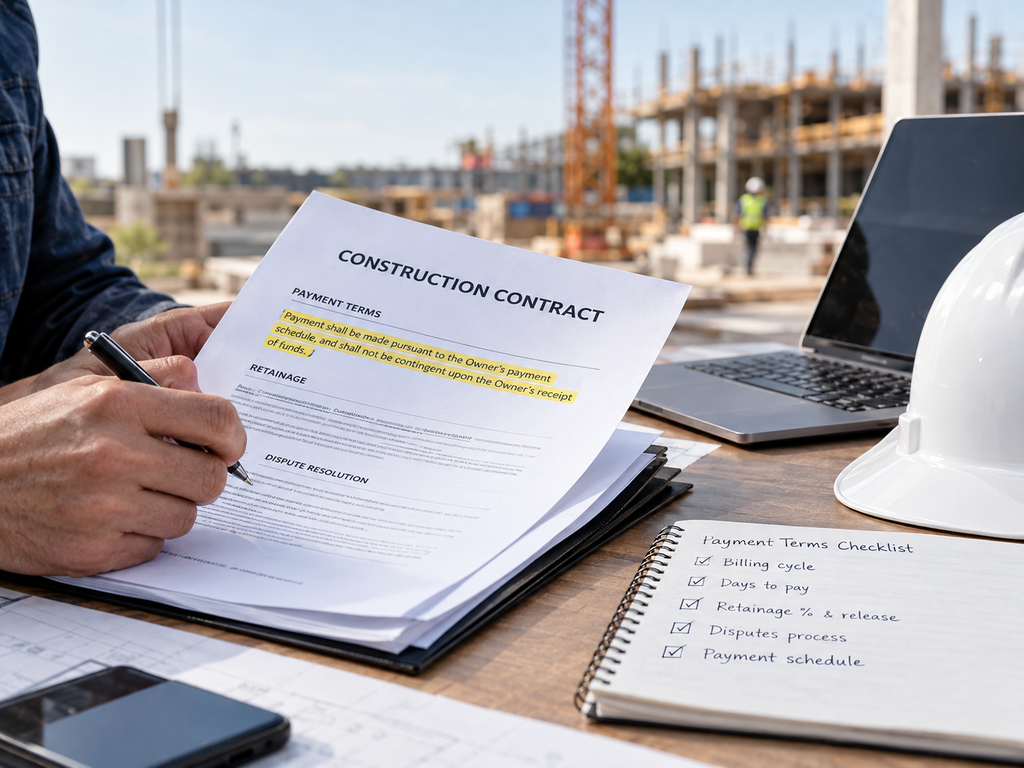
Sound subcontractor payment terms stand on their own. They describe what you did and when you get paid for it, and they do not reference anybody else’s transaction.
Reasonable construction contract payment terms will usually include a defined billing cycle, a fixed number of days from approved invoice to payment, a stated retainage percentage with release conditions, and a clear process for handling disputed amounts that does not freeze the undisputed portion.
Good payment schedules are dated. Tied to milestones you control, or to a calendar, not to a condition somebody else has to satisfy.
What to say when it shows up
Keep it short, professional, and consistent. You are not accusing anyone of anything. You are describing how your company operates.
“We don’t sign pay when paid or pay if paid language. Our payment terms need to stand on their own, independent of the owner’s schedule. Everything else in here works for us.”
Some GCs strike it without discussion, because they included it as standard language and it was never load bearing for them. Some will negotiate. A few will tell you it is non negotiable, and that answer is information worth having, because it tells you how the rest of the relationship will go when money gets tight.
Sometimes the best decision is to walk away. Not every job is worth taking, and a job that puts your payroll at the mercy of a stranger’s financing is near the top of the list of jobs worth losing.
If you already signed one
Do not panic, and do not stop working without advice, because walking off a job has its own consequences.
Find out how your state treats the specific language you signed, because that varies considerably and it changes your position. Protect your lien rights by tracking every preliminary notice deadline, since those rights are often independent of the contract clause and they expire quickly. Document everything. Invoice on schedule whether or not you expect payment. Follow up in writing, not by phone, so there is a record. And get an attorney involved earlier than feels comfortable.
Most construction payment disputes are not won by whoever is right. They are won by whoever has the documentation and the preserved deadlines.
The Bigger Picture
Every conversation about construction contract risks eventually comes back to the same question: which risks are yours to carry, and which belong to someone else?
Weather risk is yours. Productivity risk is yours. Estimating risk is absolutely yours, and if you price a job badly that is your problem to solve. Those are the risks you get paid to manage, and managing them well is what separates a professional operation from an amateur one.
The owner’s ability to fund the project is not your risk. You have no visibility into it, no relationship with the person responsible, and no ability to influence the outcome. Accepting that risk gets you nothing. There is no premium attached to it, no higher margin, no preference on the next job.
Subcontractors who accept these clauses live with constant uncertainty, because they have no control over the single most important piece of any project: when the money shows up. Subcontractors who reject them build stronger, steadier businesses, because they have drawn a firm line about who they will and will not work for.
Your responsibility is to protect your company, protect your people, and protect the cash flow that keeps your doors open. The GC’s relationship with the property owner should have no bearing on whether or when you get paid.
Your payment terms must stand on their own.
Frequently Asked Questions
It depends on your state. Many states enforce pay when paid provisions as timing clauses, giving the GC a reasonable period to collect before paying. Several states void or sharply limit pay if paid clause language that makes owner payment a condition precedent. Because treatment varies and the wording matters, have an attorney licensed in your state review the actual clause rather than relying on a general rule.
Pay if paid generally means that if the owner never pays, the GC never owes you. Pay when paid generally means you are still owed, but payment is delayed until the GC collects. The practical effect on your construction payment timing is similar, which is why the recommendation is the same for both.
Often yes, because lien rights are created by statute rather than by your contract, though some contracts attempt to waive them and some states restrict what can be waived. Lien deadlines are short and unforgiving, so track your preliminary notice dates from the day you start and consult an attorney as soon as a payment issue surfaces.
Terms that stand alone. A defined billing cycle, a fixed number of days from approved invoice to payment, stated retainage terms with release conditions, and a dispute process that does not hold up undisputed amounts. Nothing in your payment provisions should reference the owner’s payment to the GC.
Treat that as information. A GC who cannot pay without collecting first is telling you how they are capitalized, and that affects every job you do with them, not just this one. Decide whether you can absorb that exposure. For many payment disputes, the warning was visible before anyone signed.
This article reflects Don Bronchick’s experience operating trade businesses in residential construction. It is not legal advice. Contract law varies by state and by the specific language in front of you, so have a licensed attorney review your contracts before signing.